
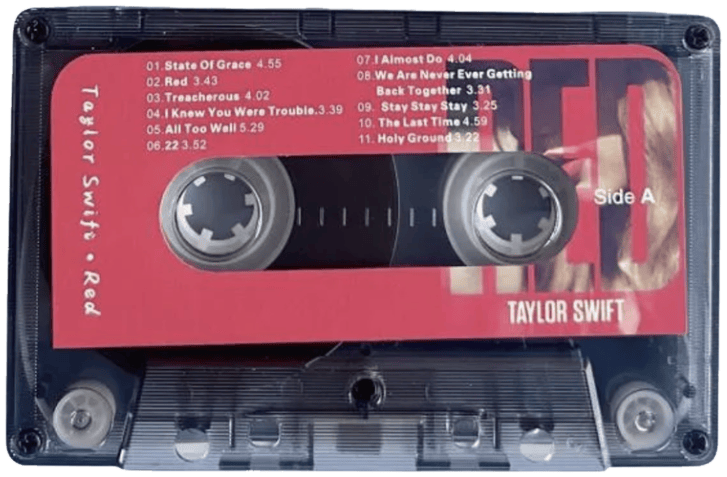
Released: October 22nd, 2012
Something is in the air this time of year and this throwback goes hand in hand with it. 14 years ago today Taylor Swift released her fourth studio album Red, opening up an era to last a lifetime. There was something so powerful about this album, listening to it and dancing around the room as an eight year old, bringing it with me everywhere I went on my iPod mini. A hit then, and possibly an even bigger hit now, even all these years down the road. Let’s talk about why the high never subsided.
The album opens up with “State of Grace,” a track with booming drums giving the rushing feeling of pushing through traffic on foot. She references the “four blue eyes,” referring to those of herself and the great Jake Gyllenhaal, who famously breaks her heart over and over again throughout the entire album.
“State of Grace” is a smitten statement that tells us she never could have expected this type of relationship, but it stops her in her tracks. He is her weakness and she knows that it was wrong to begin with. This person that she never saw coming has changed her forever.
The next two tracks, “Red” and “Treacherous,” go through these kinds of stages. “Red” explains to us the fiery passion that came with the relationship, flashing forward to the feelings and phases that came with the ending. Of all the different descriptions that tell us what being with him was like, the most famous and shtick statement, “Loving him was red,” becomes our essential point of Taylor being a person that lives in color, associating feelings with different colors and using them as a way to release her emotions.
“Treacherous” explains the intimacy that she felt with him, poetically explaining the feeling of wrongness she felt with him yet shamefully still needing him. The bridge in this one is especially powerful. She understands that even though it is not okay, she desperately wants him near her, dying to “get you, and get you alone.”
Track 4, “I Knew You Were Trouble,” takes a break from the tragedy of Jake Gyllenhaal and moves into the drama-filled perspective on her meeting Harry Styles. From the moment she saw him she knew it wouldn’t be good. She knew that he would be bad for her, but she is mindless to him. She is intrigued and wants to follow him and give into her desires. The song itself is a dramatic and tragic sounding pop song for something that probably, in hindsight, just wasn’t that deep. More on this topic in 1989 though.
And now, back to Gyllenhaal, back when “All Too Well” was just five minutes and thirty seconds long. It’s clear here that the breakup has sunk in, an eruption of sadness and second guessing. The one thing she holds onto is knowing that he may act like he forgot about her, but keeping that “old scarf from that very first week” reminds her that something about her stuck with him.
The next few tracks range in emotion and take us through the motions of a true breakup: wanting to be sad forever, getting a little better, complete 180 fuck them, and back to wanting them again. This starts with “22,” an anthem written to get over a breakup and go out with your girls to find something new and refreshing.
The feeling gets brought back down in “I Almost Do” with a description of what it is like to fight the feeling of calling them back, wondering or even knowing that they are thinking about you too. She comes clean and admits that she can’t forget about him and that “it takes everything in me, not to call you,” wishing that the person you lost could help you get over them.
Similarly to “22,” we face the complete 180 in “We Are Never Ever Getting Back Together.” Pettiness and fun, it represents more of a rebound, get off the couch and go out and forget him type of vibe. “Stay Stay Stay” has a similar upbeat tone even though the song talks about an argument between a couple. This one doesn’t exactly give an indication that it’s about a specific person. It’s kind of just a cute song about a totally average couple.
The tone goes back to that never ending cycle of missing the person she hates that she still loves in “The Last Time.” Gary Lightbody and Taylor collab to tell that story of running back to someone over and over again, creating this messy slew of thoughts. Going through all the lasts of the relationship in harmonization, they promise it’s “the last time I’m asking you why” because if it isn’t, it will just hurt more, calling it quits and only believing it because they repeat it over and over.
Back to looking fondly on a relationship, we have “Holy Ground,” an upbeat, uplifting, and positive outlook on new love. Something I love in these songs is where she wonders about what the other person is thinking. The normalcy of saying “But sometimes I wonder how you think about it now / And I see your face in every crowd” and admitting that she overthinks and wonders how they look at her. And while all this goes down in her head, she is still dancing it out.
And switching back once more to the end of Gyllenhaal in “Sad Beautiful Tragic,” trying to get over it again and again. After this, “The Lucky One” is a refreshing recognition of a girl who seems to have it all together and gets all the praise from the crowds. A true deep dive on fame and how it can feel so lonely sometimes even though it looks so glamorous.
“Everything Has Changed” is a refreshing new view on someone new, being intrigued by them and having new positive outlooks on love and moving on. An act of kindness such as “holding the door” and a smile can change everything. Ed Sheeran as the feature on this one brings us through the perspectives of both people, continuing the metaphor of “opening up the door for you.”
This theme of something new and fun continues through “Starlight,” a fairy fun cute song about fantasies and just dancing with someone she was excited about. Someone that got her to be excited and inspired again.
The album ends on the very moving “Begin Again,” still on that idea that something new can be good. The song compares the new relationship to the old one and makes it clear that one random day, “on a Wednesday in a cafe,” it can all “begin again.”
This relationship builds her back up again and makes her more confident, while still being skeptical and surprised at some things, repeating over and over “But you throw your head back laughing / Like a little kid / I think it’s strange that you think I’m funny, ’cause / He never did.” This just shows us how this relationship is healthy and gives her things to be proud of. It is young, it is happy, it’s a recovery.
This album is iconic and takes us through so many emotions, but most of all it enforces that it is okay to be a mess after a big breakup. It is okay to take your time, go back and forth, and eventually recover and find happiness and hope again.


Leave a Reply